Watch the following video and do the comprehension activities below. After that, it would be really interesting to read about your opinions as regards this topic.
You may also share you score by sending it to my account. My nickname is "sunshine".
Showing posts with label listening. Show all posts
Showing posts with label listening. Show all posts
09 June, 2013

19 May, 2013
Listen and Write
You will find in the following site a tool that enables you to listen and write what you hear.
What for?! Just to improve your comprehension and writing, that's all.
I've selected one of the exercises:
click here
What for?! Just to improve your comprehension and writing, that's all.
I've selected one of the exercises:
click here
27 April, 2013
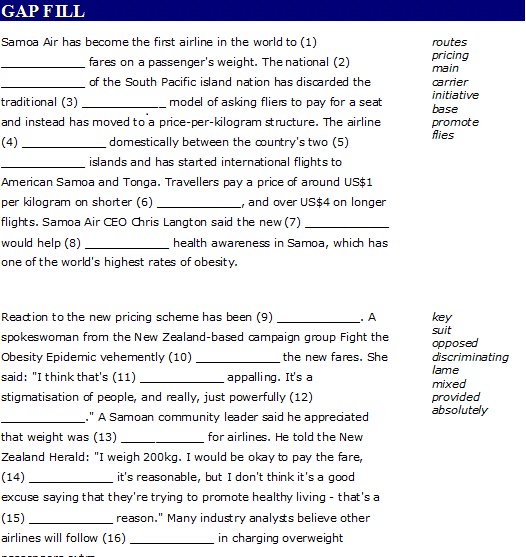
Airline Passenger
- Do the "Gap Fill" exercise.
- Prepare the article to discuss it in class.
19 April, 2013
ROBOTS
Listen to the article and decide if the following statements are TRUE or FALSE:
- You can now buy a robot in a convenience store in Japan.
- Housework has become a thing of the past in Japan.
- A new robot is on sale in Japan for $ 100,500.
- The robot has its own personality and a kind expression.
- The robot has vocabulary of 100,000 words.
- The robot can help its owners become rich and live longer lives.
- The robot will remind you to exercise.
- Most Japanese people will be able to buy one.
Match the following synonyms from the article:
| a. | unveiled | 1. collection |
| b. | consign | 2. achievement |
| c. | astronomic | 3. idea |
| d. | brainchild | 4. quotes |
| e. | collaboration | 5. relegate |
| f. | array | 6. equivalent |
| g. | cites | 7. revealed |
| h. | marvel | 8. collusion |
| i. | feat | 9. wonder |
| j. | commensurate | 10. whopping |
19 February, 2013
Could this be the perfect family dog?
Watch the video and do the exercise below:
- Is there any further information about these dogs? For example:
- How obedient are they?
- What does it require due to its size?
- How difficult are they to train?
23 November, 2012
Arctic Sea Ice Shrinks
Listen to the following news and do the True/False exercise. You'll find the correct answers in "comments"
|
a.
|
The article
says ice in Antarctica has shrunk to an all-time low.
|
|
b.
|
The article
says there may be no Arctic ice in the summer in future.
|
|
c.
|
In 2012,
there was 70,000 sq. km less ice than the previous low.
|
|
d.
|
An expert
likened the Arctic ice to a giant frozen soft drink.
|
|
e.
|
Most of the
Arctic ice melts in the summer.
|
|
f.
|
The last six
years have seen record falls in Arctic ice cover.
|
|
g.
|
The Arctic
sea ice needs to absorb the sun's rays.
|
|
h.
|
A storm that
hit the Arctic in early August made the ice stronger.
|
Bulling
Listen to the following news and do the True/False exercise. You'll find the correct answers in "comments"
a.
|
A spate of violent crime occurred in Japan’s schools this week.
|
b.
|
Japanese elementary schoolchildren are usually orderly and attentive.
|
c.
|
A government spokesman attributed the violence to video games.
|
d.
|
An elementary schoolchild decapitated a classmate a while ago.
|
e.
|
Many children lose their tempers over trivial things.
|
f.
|
Dismayed parents have installed web cameras in classrooms.
|
g.
|
Teachers say they are in control and can cope with the violence.
|
h.
|
Police statistics show juvenile delinquency is steadily increasing
|
04 November, 2012
Salt
Listen to the following file and try to do the T/F exercise below:
a. US experts say
Americans harming world salt supplies. T
/ F
b. The article says
American people have a love affair with salt. T
/ F
c. The article says
people should drive less for their health. T
/ F
d. Salt consumption in
Americans has remained stable for decades. T / F
e. Everyone is happy
about calls for a reduction of salt in food in the USA. T / F
f. One group said a
reduction in salt in food could harm people. T
/ F
g. A personal liberty
group said salt laws would attack personal freedom. T / F
h. Around 10 per cent of
American adults suffer from high blood pressure. T / F
DISCUSSION:
- What are the good and bad things about salt?
- Would you be happy without salt in your food?
- Why aren’t people cutting down on salt?
- What health problems does salt create?
- Do you always follow what food experts say?
- What would you like to drastically reduce (or
increase) in your diet?
- Is it an attack on personal freedom if the
government introduces salt laws?
22 September, 2012
Mark Salata: How taking a bath led to Archimedes’ Principle
I invite you to watch the following video and do the exercise that follows:
Salata says that some of the best opportunities to learn are the moments in which we are...
Salata says that some of the best opportunities to learn are the moments in which we are...
When and where was Archimedes born?
29 August, 2012
Movie trailer exercises for learning English
Go to the this page. You will find a movie trailer, in this case, The Return of the King, and follow the instructions on the page.
1. Click on the player to start the video.
2. Type complete words in the box below the video.
3. You can type several words before you click on "Check" to see if your answers are correct.
1. Click on the player to start the video.
2. Type complete words in the box below the video.
3. You can type several words before you click on "Check" to see if your answers are correct.
- When you have finished, practice reading the text aloud with the video.
- Do not "repeat afterwards" because it brings in an element of memorisation.
- Let your voice be guided naturally by the voices in the video - just as if you were learning a song.
24 June, 2012
Body Language
After listening to "Facial Expressions", we can watch the following video and try to draw up conclussions:
Here are some words that appear in the video:
bejesus n. Slang: Used as an intensive: The bear scared the bejesus out of us.
brisk: adj. quick, energetic, active
glaze: n. a shiny surface given to an object or a food, esp. by covering it with a liquid that shines when it dries
slant: v. to lean in a diagonal direction, or to cause (something) to slope
tilt: v. to cause (something) to move into a sloping or uneven position, or to be in this position
harbor: v. hide
fidget: v. to make continuous small movements because you are restless or bored
cluster: n. a group of similar things growing or held together, or a group of people or things that are close together
Here are some words that appear in the video:
bejesus n. Slang: Used as an intensive: The bear scared the bejesus out of us.
brisk: adj. quick, energetic, active
glaze: n. a shiny surface given to an object or a food, esp. by covering it with a liquid that shines when it dries
slant: v. to lean in a diagonal direction, or to cause (something) to slope
tilt: v. to cause (something) to move into a sloping or uneven position, or to be in this position
harbor: v. hide
fidget: v. to make continuous small movements because you are restless or bored
cluster: n. a group of similar things growing or held together, or a group of people or things that are close together
27 February, 2012
Some social English
Some of the most important phrases, responses and common expressions
used in English every day. These are sets of phrases that always go
together. Some people call them adjacency pairs. Learn many of these
vital expressions in this episode of Luke's English Podcast, one of the
fastest growing English language learning podcasts online.
Listen to Luke's podcast, it's really interesting. You will find the written expressions he mentions on this page
Rather long but quite interesting. Don't miss it!
Listen to Luke's podcast, it's really interesting. You will find the written expressions he mentions on this page
Rather long but quite interesting. Don't miss it!
Subscribe to:
Posts (Atom)